What to see inside the Château de Beynac
Arriving without a car?Every car park in the village is paid, all year, and the top one fills first in summer. A half-day tour from Sarlat drops you in the village and takes you on to Domme and the river; every option cancels free up to 24 hours before.
Check availabilityThe barbican and the courtyard
The approach is defensive and looks it: a nineteenth-century barbican, double crenellated walls and double moats, all of it standing on a cliff that already did most of the work. Inside the gate the courtyard opens and the keep is above you. This is where the audio commentary starts; it is downloaded to your own phone at the entrance, in several languages, and it is included in the ticket. There is no handset to borrow. What the ticket includes.
The hall of the guards and the Salle des États
The salle des gardes comes first, and then the room that gives the castle its place in the history of the Périgord. The Salle des États du Périgord is where the four barons of the province — Beynac, Biron, Bourdeilles and Mareuil — met in the fifteenth century. The same room served as the banqueting hall and as the seigneurial court, and it carries a sculpted Renaissance fireplace. The barons and the eight centuries behind the room.
The oratory and its frescoes
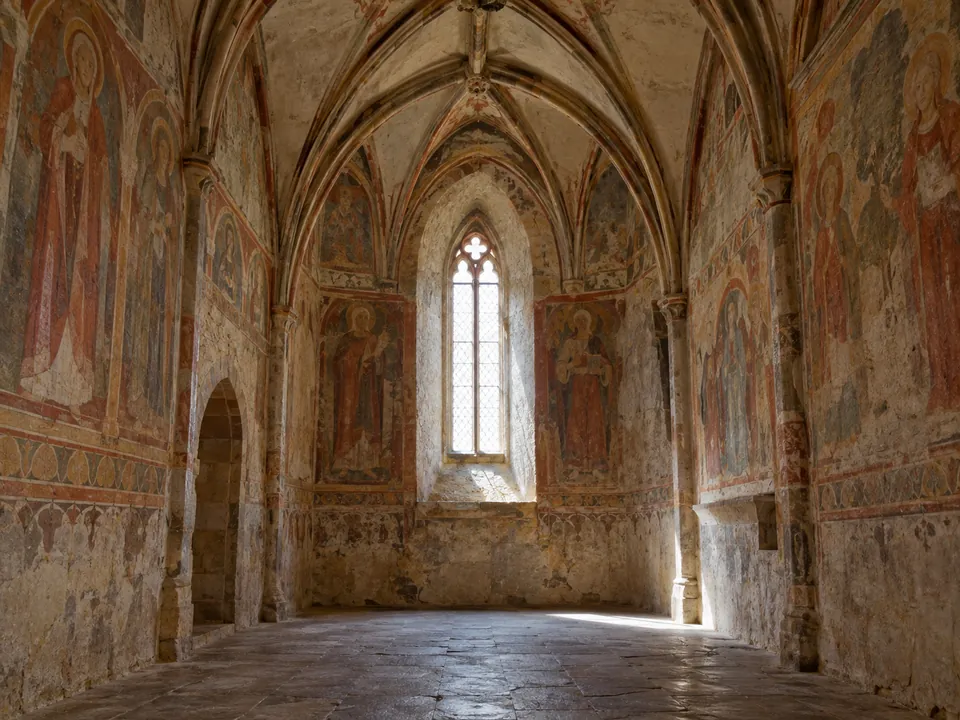
The oratory is the room people photograph least and remember most. Its fifteenth-century frescoes show a Last Supper, a Pietà, the dead Christ awaiting resurrection, and a Saint Christopher. In the Last Supper, Saint Martial is painted as the maître d’hôtel, serving the table — a local saint written into the scene by whoever commissioned it.
The stairs, the apartments and the kitchen
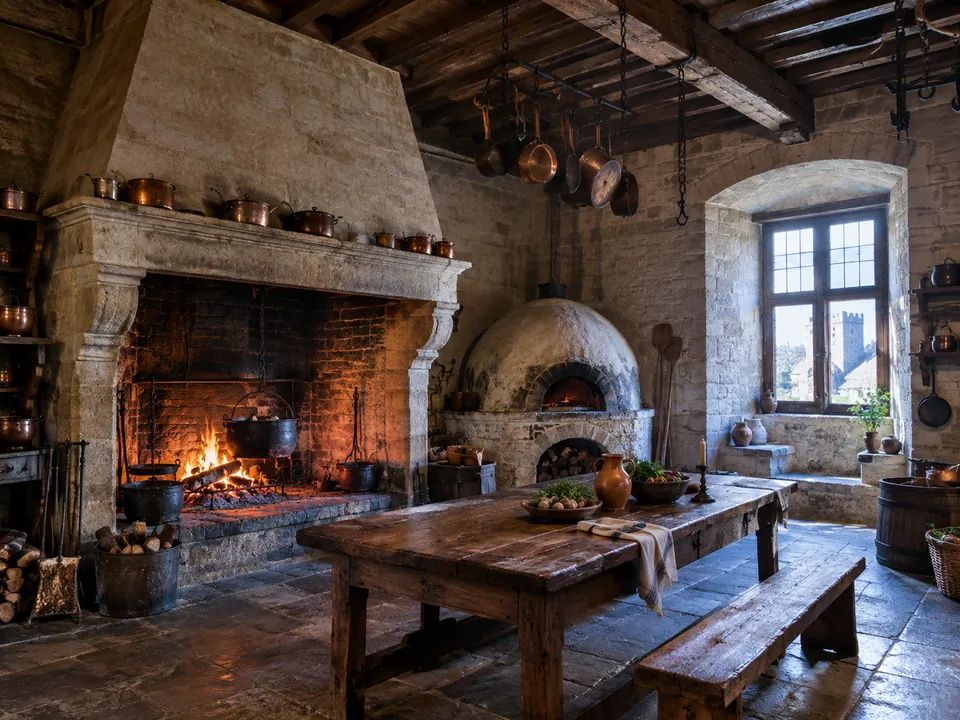
Two staircases stand beside each other and date five hundred years apart: the twelfth-century spiral stair, and a seventeenth-century open-work straight staircase in the Italian fashion added when the family wanted to live rather than hold out. The apartments above are that later castle — woodwork, painted ceilings, monumental fireplaces, and the armoury room. Below, the thirteenth-century kitchen is still a kitchen: a large fireplace, a bread oven, and hooks in the ceiling that kept the provisions out of reach of rodents. It fed the household, the servants and the sergeants-at-arms.
The keep and the spur terrace
The donjon is the oldest part, a square twelfth-century keep of stone that replaced an earlier wooden structure. The visit ends on the terrasse de l’éperon, the spur terrace, and this is the view the castle is sold on. Five castles are in sight from it at once: Beynac itself, Marqueyssac, Fayrac, Lacoste and Castelnaud. The castle’s own visit booklet and the Sarlat tourist office name the same five. The one across the river, compared.
One terrace, five castles, and a river that was a frontier for a hundred and sixteen years.
The exhibition on Beynac in the time of Richard the Lionheart and Eleanor of Aquitaine is part of the entry ticket, along with the bookshop. What Richard actually had to do with this castle.
Book entry to the castle
Entry, the Richard the Lionheart and Eleanor of Aquitaine exhibition and the bookshop, self-guided in about an hour with commentary on your own phone. From around seventeen euros, free cancellation up to 24 hours before.
Frequently asked questions
What is inside the Château de Beynac?
A twelfth-century keep, the hall of the guards, the Salle des États du Périgord, an oratory with fifteenth-century frescoes, seventeenth-century apartments with painted ceilings, a thirteenth-century kitchen and the spur terrace. About an hour.
How many castles can you see from Beynac?
Five, from the spur terrace: Beynac itself, Marqueyssac, Fayrac, Lacoste and Castelnaud. Both the castle’s visit booklet and the Sarlat tourist office name the same five.
Is the Château de Beynac a ruin?
No. It is one of the best-preserved fortresses in the region: furnished seventeenth-century rooms, painted ceilings, fifteenth-century frescoes and a medieval kitchen still in place.
Is there an audio guide at Beynac?
Yes, included in the ticket and downloaded to your own phone at the entrance, in several languages. There is no device to hire, so arrive with a charged battery. What else to bring.